
By Edidiong Udobia
In the 21st century where information is as important to a society as its legal tender, it is usually nauseating to see public office holders try to hoard their offices in the guise of being modest, when actually, they are trying cover-up their inadequacies.
A data published in the 2018 digest of the basic education statistics by the Universal Basic Education Commission (UBEC), shows that Akwa Ibom State had 581,800 out-of-school children, coming a distant second to Kano State with 989,234. Coincidentally, the period under UBEC’s review was within the time when the state education sector, for some reasons, was so obscure, that getting the least information about it required a lot of mining. For a state that has been operating a free and compulsory education policy for a over decade, the UBEC data confirms that there is a strong nexus between obscurity of public offices and failed public policies.
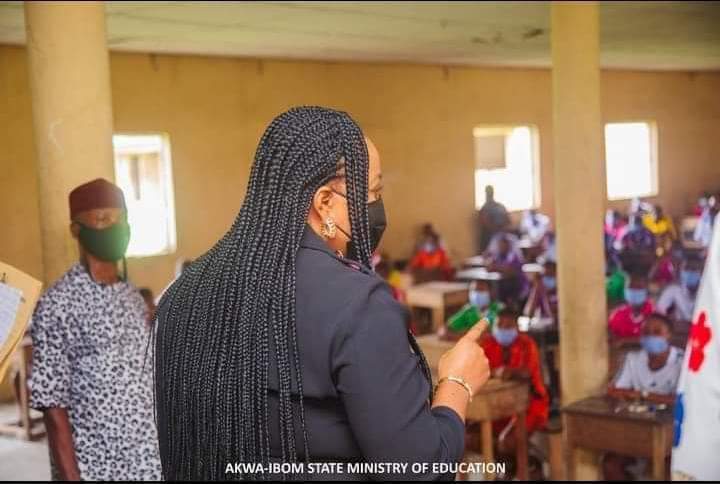
Since the appointment of Mrs Idongesit Etiebiet as state commissioner for Education, the sector has consistently been in the spotlight. Leveraging the resourcesfulness of young information professionals and media enthusiasts at her disposal, Mrs. Etiebet has turned a Ministry that was hitherto in the shadows, to one that now competes favourably for prominence. The remarkable change has a multidimensional impact, and they are all for good. First, it encourages a broader, more reliable and collective evaluation. For instance, the recent notice to parents and guardians to report all illegal charges and irregularities in public schools to the state government through designated contacts. As pedestrian as that information appeared, it was timely, and strategic enough to cause a reform in the system.
For a while, there have been rumours that despite the state government insistence on free education, some school administrators have been imposing illegal charges on parents for their children. Without knowing where to lay their complains, affected parents probably have had to either pay the illegal charges or withdraw their children all along. Apparently, the cumulative effect of this villainy also significantly contributes to the numbers of out-of-school children in the state. But with the recent notice, parents and the public will not only have the confidence to challenge the abnormalities in public schools, they also know how to easily reach the appropriate authorities. The awareness that there is an open and simple channel of communication between parents/the public and the authorities will further curb the excesses of school administrators.
Opening up the education sector to the public has not only kept people abreast with the happenings and development in the sector, but has also built people’s confidence in the system. Satisfying people’s need to know without always subjecting them to the stiffening bureaucratic bottlenecks is a shortcut to building public goodwill. Aside delegation of responsibilities, the other essence of unbundling the government into ministries, departments and agencies was to promote accessibility and encourage public interest in government business. In my thinking, the recent increase in synergy between government bodies and the participation of private individuals/institutions in the development of the education sector stems from the fact that there is an awakening in the sector.
Furthermore, the turnaround in the education sector encourages more public engagements on the successes and shortcomings in the sector. Truthfully speaking, there are many sectors in the state that are very significant to our economic and social life, but are hardly in the eyes of the public because they exist in obscurity. Awareness is a key driver of development. First, it helps to generate interest, and then encourages participation. It is through information that citizens can properly assess the priorities and performance of the government.
For starters, Mrs Etiebet has solved the perennial problem of a dormant education sector. But sustaining this energy will require collaborative efforts. For instance, during the just concluded 2021 National Book Clubs and Reading Conference, hosted in Uyo, Mrs Etiebet, who represented the state governor, Mr Udom Emmanuel, expressed the state government’s determination to revive the reading culture among students in the state and leveraging technology to advance education. In her words, “We are determined to produce future graduates who would think outside the box of conventional knowledge. We want our children to be well-rounded and be ready to compete in the marketplace of ideas and skills, which the 21st century technology-driven world demands of us”.
For me, that was an open invitation for collaboration, not only to the book clubs and other organizations promoting reading, but also to the tech community. Incidentally, Mrs Etiebet made the call about the same time that the Akwa Ibom Tech Week 2021 was also hosted in the state capital. If Akwa Ibom must meet her educational goals in the 21st century, then technology must become an integral part of its roadmap. Thankfully, the Idongesit Etiebiet led education ministry is open to collaboration. Statistics like the UBEC’s out-of-school children report will not upturn themselves, and the government will not be able to work the miracle alone. For example, finding a lasting solution to a problem like the rampant rioting among students will require committed efforts from parents, school administrators and even non-governmental organizations.
Policies, regardless how laudable they are, would only be effective when everyone involved in its implementation make commendable efforts to it. Parents must ensure that their children have the right orientation about their purpose in school. School administrators on their part, must be sincere and committed to ensuring a proper management of public schools with little or no supervision. Even critics have the responsibility of making useful recommendations. In her regular meetings with school administrators and other stakeholders in education, Mrs Etiebet has consistently emphasised on cooperation, efficiency and effectiveness. It’s still a long walk to finding a fix-all solution to the challenges facing education in the state, but having an education sector that is now a beehive, yet opened to contributions, and collaborations is a quantum leap.
Like many other citizens, my earnest desire is to see the government match this transformation with the right investments in human capacity, infrastructure, etc. With the the prominence given to the sector now, the days of hoarding its deficiencies are over. The only option before us is to collectively fix the system, one problem at a time, and watch the statistics improve.
 Aktv News